 English
 中文简体
中文简体 русский
 Français
 Español
 عربى
عربىEverything you need to understand how a DC motor turns electrical energy into rotation, how the main motor types differ, and which one fits your project or product.
A DC motor is an electric machine that converts direct current electrical energy into mechanical rotation using the interaction between a magnetic field and a current carrying conductor. When current flows through the motor windings inside a magnetic field, it creates a force described by the motor effect, and that force produces torque that spins the shaft. The three most common DC motor families are brushed DC motors, brushless DC motors known as BLDC, and stepper motors, and they are used everywhere from cordless drills and electric toothbrushes to electric vehicles, robotics arms, and industrial conveyor systems.
If you only need one takeaway, use this rule: choose a brushed DC motor for the lowest upfront cost and simplest control, choose a brushless DC motor for higher efficiency and a longer service life, and choose a stepper motor when you need precise, repeatable positioning without a feedback sensor.
How a DC Motor Actually Works
The working principle behind every DC motor, no matter the size or price, comes down to one law of physics applied inside a compact housing.
A DC motor works because of the Lorentz force, the same force that pushes a current carrying wire when it sits inside a magnetic field. Inside the motor, a set of coils called the armature sits between two magnetic poles, usually a north pole and a south pole created by permanent magnets or electromagnets. When direct current flows through the armature coils, each coil becomes a temporary magnet. The interaction between the coil field and the surrounding magnetic field pushes one side of the coil up and the other side down, which creates a rotating force, or torque, on the shaft.
For the rotation to continue smoothly instead of stopping at a balance point, the current direction inside the coil has to flip every half turn. In a brushed motor this flipping is handled mechanically by a component called the commutator, paired with carbon brushes that press against it. In a brushless motor the same job is done electronically by a controller that switches current through the windings in sequence, guided by position sensors or by reading the back electromotive force of the motor itself.
- Step one, current enters the windings. Direct current from a battery or power supply reaches the armature coil through the brushes and commutator, or through an electronic driver in a brushless design.
- Step two, a magnetic force is generated. The current carrying coil sitting inside the permanent magnetic field experiences a push described by the motor effect.
- Step three, torque spins the shaft. The push on the coil becomes rotational force on the shaft, and the shaft drives whatever load is attached to it.
- Step four, commutation keeps it spinning. Current direction is switched at the right moment so the torque keeps acting in the same rotational direction instead of canceling out.
Simplified cross section: the armature coil sits between two magnetic poles and rotates when current flows through it.
The Main Components Inside a DC Motor
A DC motor is a fairly small collection of parts, and knowing what each one does makes it much easier to troubleshoot or specify a replacement.
| Component | Function | Typical Material |
| Stator or field magnet | Creates the fixed magnetic field the rotor spins inside | Ferrite, neodymium, or wound electromagnet coils |
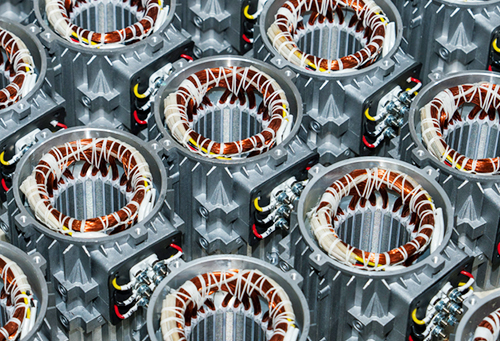
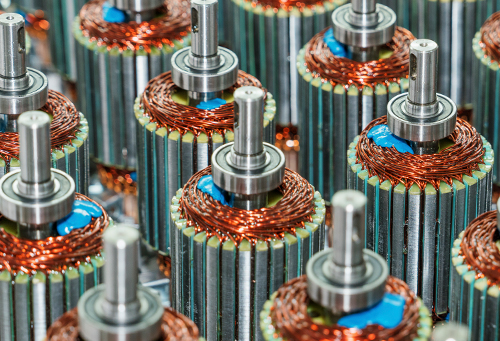
| Armature or rotor | Carries current and produces the rotating force | Copper wire wound around a laminated steel core |
| Commutator | Reverses current direction in brushed motors to keep torque constant | Copper segments insulated from each other |
| Brushes | Carry current from the power supply into the rotating commutator | Carbon or carbon graphite blend |
| Bearings | Support the shaft and reduce friction during rotation | Sealed ball bearings or bushings |
| Housing or frame | Holds all parts in alignment and dissipates heat | Steel, aluminum, or engineered plastic |
| Controller, brushless designs only | Switches current through windings using sensor or sensorless timing | Electronic circuit board |
Types of DC Motors and How They Compare
Not every DC motor is built the same way. Manufacturers vary how the field magnet and armature windings are connected, and that changes the torque and speed behavior significantly.
| Motor Type | How It Works | Typical Efficiency | Best Use Case |
| Brushed permanent magnet | Fixed magnets create the field, brushes and a commutator switch current | 75 to 80 percent | Toys, low cost tools, simple appliances |
| Brushless DC, BLDC | Electronic controller switches current, no physical brushes | 85 to 95 percent | Drones, electric bikes, computer cooling fans, power tools |
| Series wound DC | Field and armature windings connected in series | 70 to 85 percent | Starter motors and applications needing very high starting torque |
| Shunt wound DC | Field and armature windings connected in parallel | 75 to 85 percent | Applications needing constant speed under varying load |
| Compound wound DC | Combines series and shunt windings for a blended torque and speed curve | 75 to 85 percent | Elevators, rolling mills, presses |
| Stepper motor | Rotates in fixed angle steps driven by pulsed current | Varies by load, optimized for position accuracy over efficiency | 3D printers, CNC machines, camera gimbals |
| Servo motor, DC based | DC motor plus a feedback sensor and closed loop controller | 80 to 90 percent | Robotics, RC vehicles, precision automation |
Brushed DC Motors vs Brushless DC Motors
This is the comparison most buyers actually need to make, since brushed and brushless motors cover the majority of consumer and industrial products on the market.
Lower Cost, Simpler Control
- Runs directly from a battery or DC supply with no controller required
- Brushes wear down over time, typical service life is around 1000 to 3000 hours of continuous use
- Friction from the brushes wastes roughly 5 to 10 percent of input energy as heat
- Simple speed control using pulse width modulation or a variable resistor
- Good choice for low duty cycle products like toys, hand mixers, and basic pumps
Higher Efficiency, Longer Life
- No brushes to wear out, typical service life can exceed 20000 hours
- Efficiency commonly reaches 85 to 95 percent because there is no brush friction
- Requires an electronic speed controller to switch the windings correctly
- Runs cooler and quieter, which matters in drones, fans, and medical devices
- Higher upfront cost due to the controller and precision manufacturing
Key Specifications to Check Before Buying a DC Motor
Motor datasheets list several numbers at once, and each one tells you something different about how the motor will behave under load.
| Specification | What It Tells You | Typical Range |
| Rated voltage | The DC voltage the motor is designed to run on continuously | 1.5 volts for small hobby motors up to 600 volts for industrial units |
| No load speed | Rotational speed with nothing attached to the shaft, measured in RPM | 3000 to 12000 RPM for small motors, 750 to 3600 RPM for industrial motors |
| Rated torque | How much rotational force the motor can deliver continuously without overheating | A few millinewton meters for micro motors up to several hundred newton meters for industrial motors |
| Stall current | Current draw when the shaft is fully blocked, useful for sizing wiring and fuses | Often 5 to 10 times the rated running current |
| Efficiency | Percentage of electrical input converted into usable mechanical output | 70 to 95 percent depending on motor type |
| Duty cycle | How long the motor can run continuously before it needs to cool down | Continuous duty or intermittent duty, often listed as a percentage per cycle |
| Shaft diameter and mounting pattern | Mechanical compatibility with your coupling, gearbox, or housing | Varies by manufacturer, always confirm against your drawing |
Real World Applications of DC Motors
DC motors show up in far more products than most people realize, because they are easy to control and scale from millimeter sized parts to industrial equipment.
Consumer Electronics
Electric toothbrushes, hair clippers, camera autofocus modules, and cooling fans inside laptops and game consoles.
Power Tools
Cordless drills, angle grinders, and impact drivers rely on brushed or brushless DC motors for high torque in a compact body.
Automotive
Starter motors, power window motors, windshield wiper motors, seat adjusters, and increasingly full electric vehicle drivetrains.
Robotics
Servo motors and stepper motors position robot arms, camera gimbals, and mobile robot wheels with repeatable accuracy.
Medical Devices
Infusion pumps, surgical tools, and powered wheelchairs use brushless DC motors for quiet, reliable, low maintenance operation.
Industrial Automation
Conveyor belts, packaging lines, and CNC machine axes use DC and stepper motors for controllable speed and positioning.
Aerospace and Drones
Multirotor drones depend on lightweight brushless DC motors for the high power to weight ratio needed for flight.
Home Appliances
Washing machines, kitchen mixers, vacuum cleaners, and HVAC blower fans use DC motors for variable speed control.
How to Choose the Right DC Motor for Your Project
Follow these steps in order and you will avoid the most common motor selection mistakes, which are undersizing torque and ignoring duty cycle.
- Define the load first. Calculate or estimate the torque and speed your application actually needs at the shaft, not just at the motor.
- Add a safety margin. Size the motor for at least 20 to 30 percent more torque than your calculated requirement to cover friction losses and startup spikes.
- Match the voltage to your power source. A motor rated for 24 volts will underperform on a 12 volt battery and can be damaged on 48 volts.
- Decide between brushed and brushless. Choose brushed for low cost and simple control, choose brushless when efficiency, noise, and lifespan matter more than upfront price.
- Check the duty cycle. A motor rated for intermittent use will overheat if it is run continuously at full load.
- Confirm the mechanical fit. Shaft diameter, mounting holes, and overall dimensions must match your housing or gearbox before you commit to a purchase.
- Plan the control method. Simple on and off use needs only a switch or relay, while variable speed needs a pulse width modulation driver or a dedicated motor controller.
Common DC Motor Problems and Maintenance Tips
Most DC motor failures fall into a short list of predictable causes, and catching them early usually costs far less than a full motor replacement.
| Symptom | Likely Cause | Recommended Fix |
| Motor runs weak or slow | Worn brushes, low supply voltage, or a partially blocked commutator | Inspect and replace brushes, check supply voltage, clean the commutator surface |
| Motor overheats quickly | Running beyond rated duty cycle or a mechanical load that is too high | Reduce continuous run time or upgrade to a motor with higher rated torque |
| Unusual noise or vibration | Worn bearings or a misaligned shaft coupling | Replace bearings and re-check shaft alignment with the coupling or gearbox |
| Motor does not start | Broken brush contact, blown fuse, or a failed electronic controller in a brushless unit | Test voltage at the motor terminals and inspect the controller board |
| Sparking at the brushes | Normal in brushed motors under load, but excessive sparking signals worn brushes or a damaged commutator | Replace brushes and resurface or replace the commutator if scoring is visible |
DC Motors vs AC Motors: Which One Do You Actually Need
DC and AC motors solve different problems, and the choice usually comes down to your power source and how precisely you need to control speed.
| Factor | DC Motor | AC Motor |
| Power source | Direct current, batteries or a rectified supply | Alternating current, directly from the grid |
| Speed control | Simple, adjust voltage or use pulse width modulation | Requires a variable frequency drive for smooth control |
| Starting torque | High starting torque, good for heavy startup loads | Generally lower starting torque unless specifically designed for it |
| Maintenance | Brushed types need periodic brush replacement, brushless types need very little | Low maintenance, no brushes in most designs |
| Typical use | Battery powered devices, robotics, electric vehicles | Industrial pumps, fans, and equipment running directly from mains power |
Frequently Asked Questions About DC Motors
Quick answers to the questions buyers and hobbyists ask most often.
What voltage does a DC motor need to run
It depends entirely on the motor rating. Small hobby motors often run on 1.5 to 12 volts, while industrial DC motors can be rated anywhere from 24 volts up to several hundred volts. Always match the supply voltage to the motor nameplate rating.
How long does a DC motor typically last
A brushed DC motor usually lasts around 1000 to 3000 hours of continuous operation before the brushes need replacement. A brushless DC motor can last more than 20000 hours because there is no brush wear involved.
Can a DC motor run on AC power
Not directly. A DC motor needs direct current, so if your only power source is AC, you need a rectifier or an AC to DC power supply between the outlet and the motor.
Why does my DC motor get hot during use
Some warmth is normal because no motor is 100 percent efficient, but excessive heat usually means the motor is running beyond its rated duty cycle, the load is too high, or airflow around the housing is blocked.
Is a brushless DC motor worth the extra cost
For products that run often, need quiet operation, or need a long service life, yes. The higher efficiency and near zero maintenance usually pay back the extra upfront cost over the life of the product.
DC motors remain one of the most practical ways to turn electrical power into controlled motion, from a one dollar toy motor to a multi kilowatt industrial drive. Once you understand the working principle, know the main types, and check the specifications that matter for your load, choosing the right motor becomes a straightforward engineering decision rather than a guess.